Filed by Buster Barkley, lead correspondent
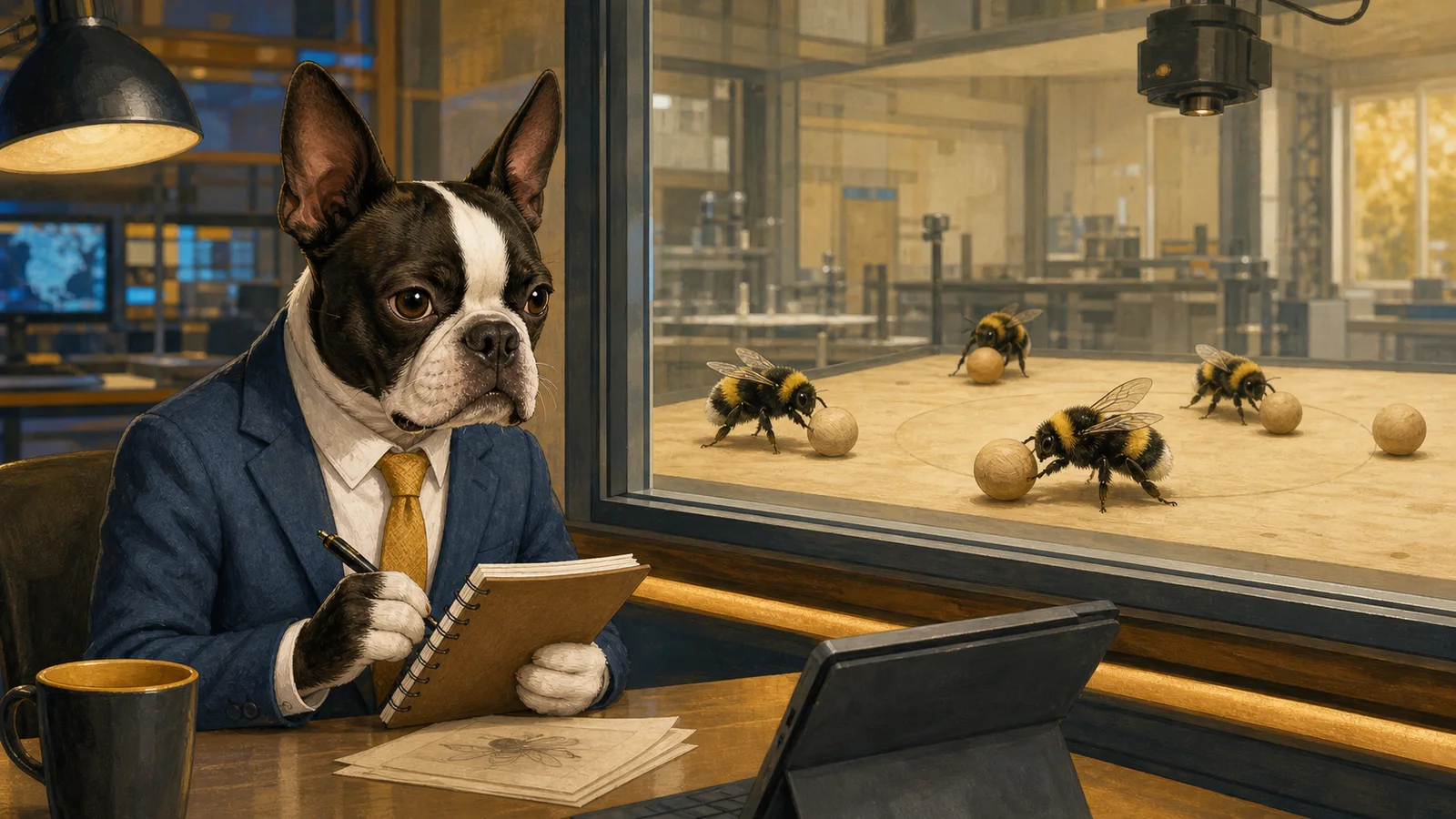
Bumblebees have now added “rolling wooden balls for no obvious practical reason” to the list of activities science must investigate with a straight face.
In a peer-reviewed study published in Animal Behaviour, researchers reported that buff-tailed bumblebees repeatedly rolled small wooden balls even when the activity offered no food and was not required to reach food. The research team concluded that the behavior met established criteria for animal play.
This was not bee soccer. There were no goals, uniforms, referees, or lucrative transfer negotiations. There were simply bees and movable balls.
The balls were optional, which is the whole point
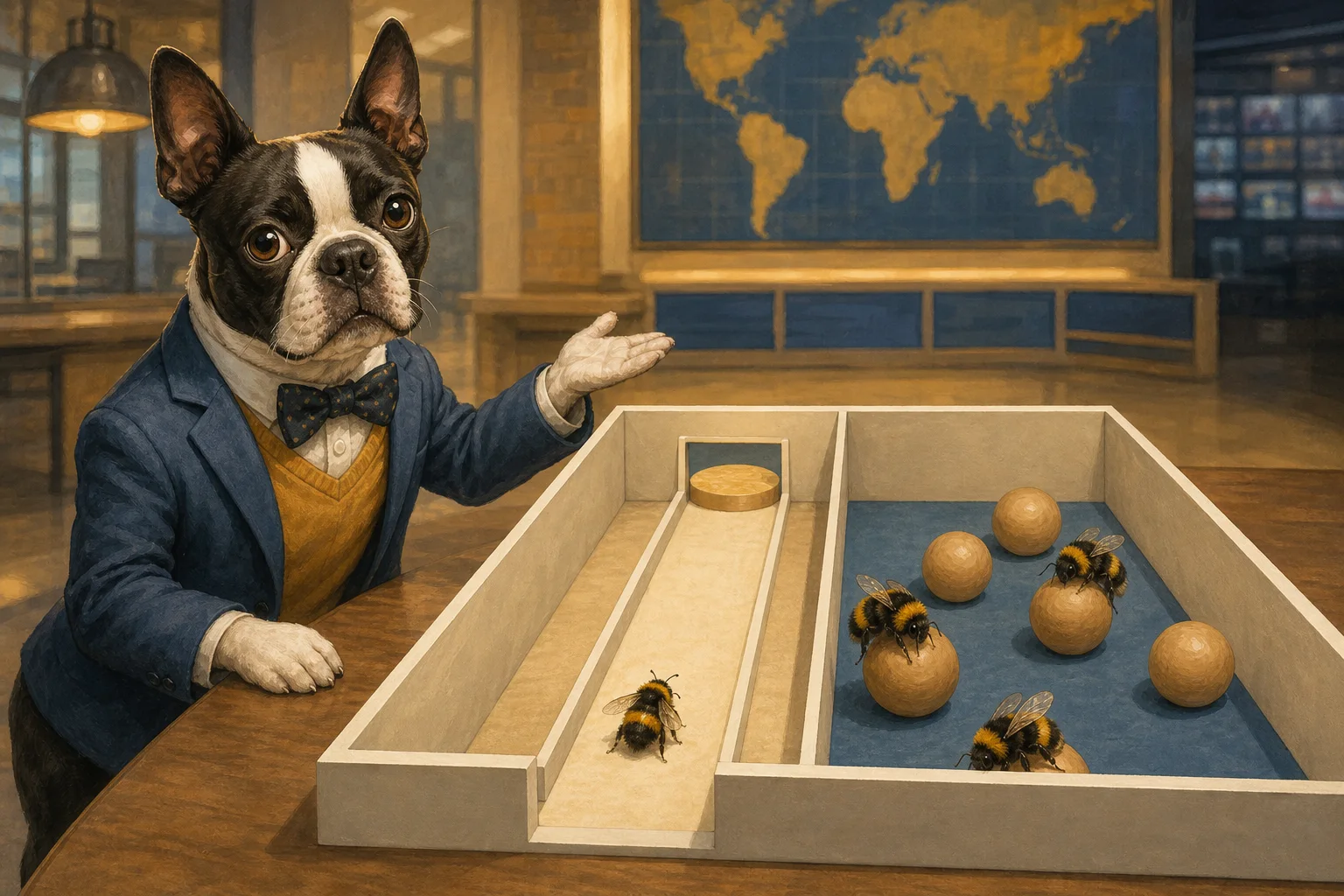
The researchers designed their experiments to test whether ball rolling was useful for immediate survival or whether the bees might be clearing clutter, looking for food, or performing mating behavior. Their observations did not support those practical explanations.
Instead, ball rolling was voluntary, repeated but not rigidly identical, and initiated under low-stress conditions. The bees could travel through the setup without rolling anything. Some returned to the balls anyway.
Younger bees were the busier players
The study found age and sex differences. Younger bees rolled more balls than older bees, a pattern the authors compared with the greater frequency of play in younger mammals. Male bees spent longer on individual rolls than female bees.
In another part of the research, bees learned to associate one colored chamber with access to movable balls. When later tested without the balls, they preferred the color that had been paired with rolling. The authors interpreted that result as evidence that the activity itself was rewarding.
The finding matters beyond the obvious appeal of tiny insects choosing tiny toys. Play is often discussed in relation to mammals and birds. Evidence that an insect may engage in a positive, self-directed activity adds to questions about how scientists understand insect cognition and affective states.
A careful conclusion, with excellent footage
The paper does not say that every bee has a favorite sport, nor does it turn a laboratory behavior into a claim about all insects. It reports that these bumblebees’ ball rolling satisfied the behavioral criteria the researchers used for play.
That is a measured scientific conclusion. It is also, by extraordinary good fortune, about bees playing with balls.
Sources: Dona et al., “Do bumble bees play?” in Animal Behaviour; Queen Mary University of London research summary.