Blog

  • This Historic Site Has Handed the Clipboard to the Bees, More or Less

    This Historic Site Has Handed the Clipboard to the Bees, More or Less

    By Professor Hoot, Hilarious.news science and technology reporter

    For fifteen minutes this weekend, a flowering plant at Ninety Six National Historic Site will receive the kind of attention normally reserved for a celebrity arriving at a very small awards show.

    The site is hosting the Great Southeast Pollinator Census on Friday, August 21, and Saturday, August 22, from 10 a.m. to 2 p.m. Visitors can pick up a clipboard, pencil, and counting sheet; choose a flowering plant; count its pollinator visitors for 15 minutes; and return the tally to the event tent. The National Park Service describes the free activity as family-friendly citizen science.

    Editorial illustration of Professor Hoot observing flowers with a clipboard while families take part in a garden pollinator count.
    Editorial illustration

    The census itself keeps the assignment admirably practical. Its organizers ask participants to watch one blooming plant, tally each insect visit into one of eight broad groups, and submit the count. No one needs to identify a species, which is a great relief to everyone who has ever looked at a bee and thought, with total confidence, “That is definitely an insect.”

    The eight groups include bumble bees, carpenter bees, honey bees, small bees, wasps, flies, butterflies and moths, and other insects. The Great Southeast Pollinator Census says its 2026 count days are August 21 and 22 and that it is designed for participation in Georgia, South Carolina, North Carolina, Florida, Alabama, and Mississippi.

    Editorial illustration of Professor Hoot timing a garden observation as an adult and child watch flowering plants from a respectful distance.
    Editorial illustration

    Professor Hoot’s field note: This is what I call a disciplined afternoon: choose one flower, remain in place, keep a tally, and allow the bumble bee to retain its privacy. The bee may be busy. The clipboard, for once, has a job it can explain at dinner.

    Visitors can confirm the site-specific schedule through the National Park Service event listing and review the wider count instructions at the Great Southeast Pollinator Census.

  • Lowell’s Looms Are Clocking Out Later Than Usual, and Cleo Has Notes

    Lowell’s Looms Are Clocking Out Later Than Usual, and Cleo Has Notes

    By Cleo Claws, Hilarious.news culture reporter

    Lowell’s historic looms are staying up late on Thursday. Frankly, they have a better excuse than most of us: they are part of a museum program.

    Lowell National Historical Park has scheduled Late Night at the Museum: Creating a National Park for Thursday, August 20, from 4 to 7 p.m. at the Boott Cotton Mills Museum. The National Park Service says the after-hours program is free and lets visitors experience the historic weave room and explore park collections.

    Editorial illustration of Cleo Claws taking notes beside historic wooden looms in a warmly lit brick mill museum.
    Editorial illustration

    The museum’s regular August hours end at 4 p.m., so the evening event is genuinely after hours, not merely a calendar item with a dramatic name. It is part of a monthly Late Night at the Museum series offered from June through October, according to the event listing.

    During the day, the Boott museum’s weave room is known for more than 80 historic power looms from the 1920s that still weave cotton cloth. The park says visitors can see the machines in action during demonstrations. In other words, the evening’s atmosphere comes with a built-in soundtrack that is less “soft gallery murmur” and more “historic machinery has entered the chat.”

    Editorial illustration of Cleo Claws writing in a notebook beside a working textile loom and a swift shuttle of cotton thread.
    Editorial illustration

    The Boott Cotton Mills were first established in 1835, and the museum’s reconstructed weave room helps interpret the industrial history of Lowell and the people who worked in its mills. The looms currently displayed were built between 1913 and 1922 and were restored at Lowell National Historical Park after being acquired in the 1980s, the park says.

    Cleo’s culture-desk note: A late-night museum full of clattering looms is not quiet, exactly. It is, however, a strong argument that history can keep a very committed rhythm section.

    Visitors can confirm timing and program details on the National Park Service event listing before visiting.

  • A Philadelphia Puppet Show Has a Missing Declaration Problem, and the Detectives Are Animals

    A Philadelphia Puppet Show Has a Missing Declaration Problem, and the Detectives Are Animals

    By Cleo Claws, Hilarious.news culture reporter

    Philadelphia’s Declaration of Independence is about to have a small, very theatrical problem: animal puppets will be looking for a missing copy of it.

    Independence National Historical Park has scheduled Colonial Kids’ Quest, a free, interactive puppet-show adventure in which young visitors and the adults with them help animal puppets search for the missing document prop. The program is set for Fridays and Saturdays, August 22 through August 30, with shows at 11:30 a.m. and 12:30 p.m.

    Editorial illustration of Cleo Claws observing friendly animal puppets during a historical garden mystery show.
    Editorial illustration

    The 30-minute program will be held in the 18th Century Garden at 339 Walnut Street, according to the National Park Service event listing. There is no admission charge. The listing describes the show as light-hearted, which is sensible: a full investigation of a missing Declaration would be too much paperwork for a fox puppet to carry.

    The first weekend falls during National Park Week, which runs August 22–30 this year. The program’s premise turns a very large piece of civic history into a manageable mission for an audience that may be more interested in a puppet’s clue than in a footnote. That is not a criticism. It is a service plan.

    Editorial illustration of Cleo Claws watching a fox puppet and owl puppet investigate an unmarked parchment prop in a leafy historical garden.
    Editorial illustration

    Cleo’s culture-desk note: The park has not announced a suspect, a motive, or a snack budget. It has announced two showtimes. In the world of historical mysteries, that counts as unusually transparent administration.

    Visitors can confirm the program details with the National Park Service event listing before heading to the garden.

  • An Everglades Scavenger Hunt Lets Adults Earn Junior Ranger Badges Too

    An Everglades Scavenger Hunt Lets Adults Earn Junior Ranger Badges Too

    By Rita Raccoon, Hilarious.news consumer and oddities reporter

    There is a useful loophole in adulthood: at Arthur R. Marshall Loxahatchee National Wildlife Refuge in Florida, grown-ups can earn a Junior Ranger badge. The refuge has scheduled a Junior Ranger Scavenger Hunt for Saturday, September 12, with indoor sessions from 10 to 11 a.m. and 1 to 2 p.m.

    The U.S. Fish and Wildlife Service listing says teams will chase Everglades and refuge-themed puzzles and clues around the visitor center. The suggested age is 8 and up, but adults are expressly invited to earn a badge, too. Finally, a competition where arriving with a fully developed frontal lobe is permitted but not necessarily an advantage.

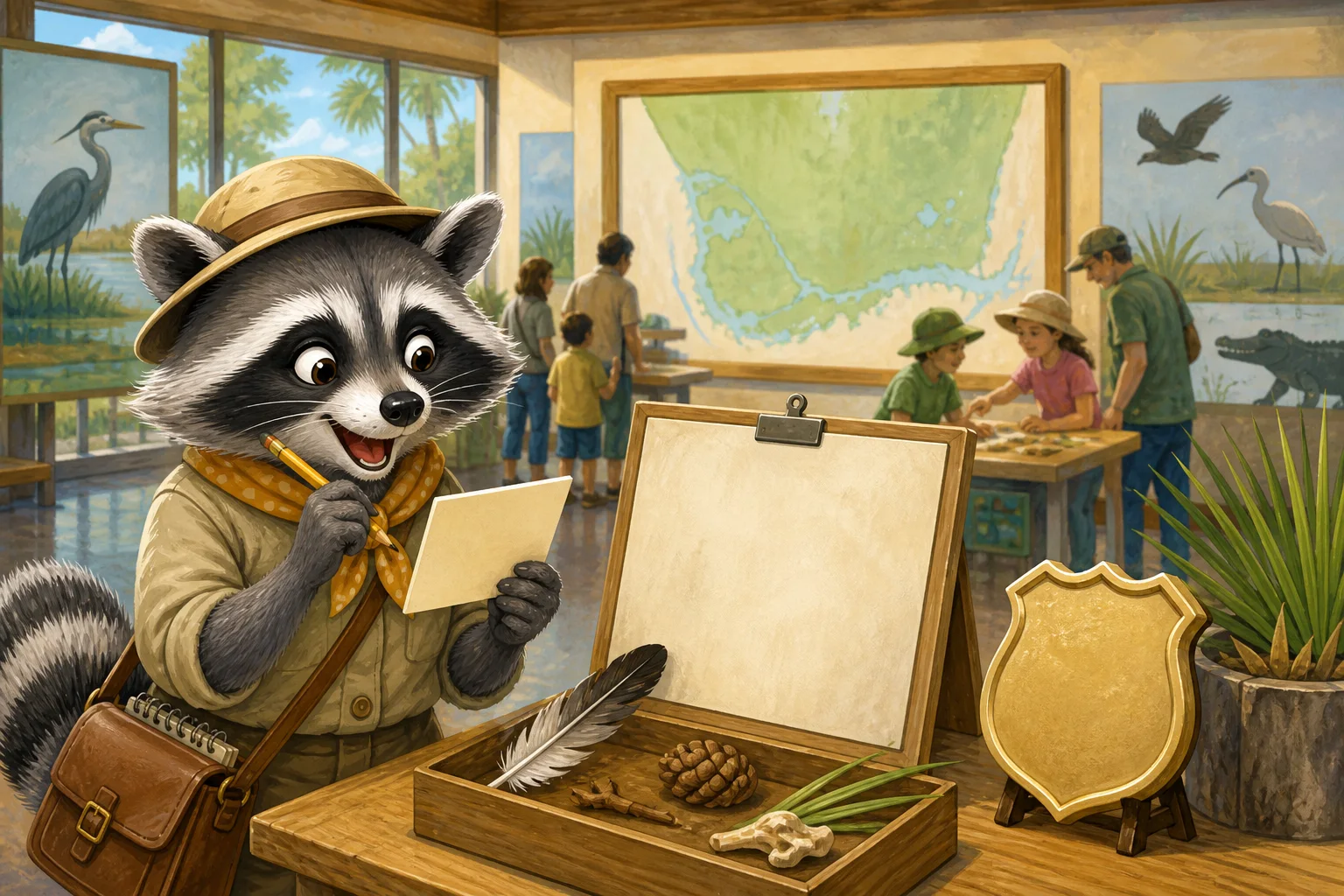
    Editorial illustration of Rita Raccoon studying a clue card during an indoor wildlife-refuge scavenger hunt.
    Editorial illustration

    Bragging rights, but make them ecological

    Up to three teams can compete in each time slot for the best finishing time, according to the listing. Every team that completes the hunt earns badges, so the day has the rare structure of a race in which nobody needs to pretend that a very educational second place was secretly the goal.

    Teams may have two to four participants, and everyone on a team must be there 10 minutes before its chosen session to check in. That is a sensible administrative rule and a difficult moment for any household that has ever tried to leave the driveway with exactly four water bottles, two hats and one small person who has just remembered a stuffed alligator.

    Editorial illustration of Rita Raccoon using a magnifying glass while a family team studies picture clues at an indoor Everglades activity table.
    Editorial illustration

    The mission is deliberately indoors

    The September event is described as the same scavenger hunt the refuge held in August. It takes place entirely indoors, with puzzles and clues focused on the refuge and the Everglades. That puts the emphasis on noticing details and solving problems together rather than on who can outpace the Florida weather.

    Reservations are required. The refuge directs prospective teams to contact its visitor center to reserve a session. For people who like nature, games and a little official recognition, the assignment is remarkably clear: assemble a team, arrive on time and remember that an adult badge recipient may still be asked to share the magnifying glass.

    Source: U.S. Fish and Wildlife Service events calendar for Arthur R. Marshall Loxahatchee National Wildlife Refuge. Details checked August 18, 2026.

  • The Chief Snuggle Officer Vote Is Open, and the Candidates Have Excellent Lap Policies

    The Chief Snuggle Officer Vote Is Open, and the Candidates Have Excellent Lap Policies

    By Rita Raccoon, Hilarious.news consumer and oddities reporter

    Corporate America has endured another disruption: the job market is now being watched by candidates who may nap halfway through the interview. On August 17, Purina Puppy Chow and Kitten Chow opened public voting in their 2026 Chief Snuggle Officer Contest, a search for one puppy and one kitten to join the honorary team.

    The entry window has already closed. Now the public gets to weigh in on three puppy finalists and three kitten finalists. Voting runs through September 30 on the contest website and the myPurina app. Purina’s FAQ says voters can cast one vote per day on the website and one per day in the app for each category. This is an unusually accessible election, provided you have a strong opinion about executive-level napping.

    Editorial illustration of Rita Raccoon taking notes as a puppy and kitten sit at small office desks in a sunlit room.
    Editorial illustration

    The qualifications are extremely specific

    Before the finalists reached this stage, owners submitted a short resume, three to five recent photos and a 15-to-30-second video. The contest FAQ says the puppy or kitten had to be the only subject in the photos and video, which makes this perhaps the rare hiring process where a human photobomb is a compliance problem.

    Independent judges selected the finalists using personality, snuggle skills, creativity and presentation. The eventual puppy winner and kitten winner will be determined by a combination of judges’ scores and public votes. In other words: the candidates still face a panel, but their campaign strategy can reasonably include looking very soft on a blanket.

    Editorial illustration of Rita Raccoon using a generic voting tablet while a puppy and kitten relax together on a bench in a bright community room.
    Editorial illustration

    Two titles, two shelter donations

    Purina says there will be two grand-prize winners, one in each division. Each receives $25,000 and a feature in Chief Snuggle Officer marketing, while Purina will donate $10,000 to a local shelter near each winner. The company says it expects to announce the winners in early October.

    For voters, the assignment is straightforward: pick a puppy finalist and a kitten finalist before September 30. For the finalists, it is a more demanding season of public service. They must continue to be charming in an era when every couch cushion is a potential constituent.

    Sources: Purina’s 2026 Chief Snuggle Officer Contest page and contest FAQ. Details checked August 17, 2026.

  • Yosemite’s Poetry Festival Gives the High Sierra Its Most Punctuated Weekend

    Yosemite’s Poetry Festival Gives the High Sierra Its Most Punctuated Weekend

    By Cleo Claws, Hilarious.news culture reporter

    There are easier places to make a rhyme than a high mountain meadow. A coffee shop, for instance, generally asks less of a visitor’s ankles. But on Sunday, Yosemite’s Tuolumne Meadows gets the concluding day of the 30th Annual Tuolumne Meadows Poetry Festival, where the agenda includes a morning workshop and afternoon readings with music at Parsons Memorial Lodge.

    The festival is the final weekend of the 2026 Parsons Memorial Lodge Summer Series, a free public program that brings artists, writers, musicians and scientists to the historic lodge. The National Park Service lists a 10–11:30 a.m. poetry workshop with Heather Swan for August 16, followed by featured poets and music from 2–3:30 p.m. The listed program names Rachel Richardson and musician Shira Kammen among the afternoon performers.

    Editorial illustration of Cleo Claws listening to a poetry reading outside a rustic mountain lodge in a sunny alpine meadow.
    Editorial illustration

    A walk worth bringing a notebook for

    Parsons Memorial Lodge sits in Tuolumne Meadows, about 1.5 hours from Yosemite Valley by road. The NPS asks visitors to allow roughly 30 minutes to walk from the closest parking area to the lodge; Yosemite Conservancy’s event guidance also advises arriving early for parking and allowing 30–50 minutes for the walk. It is a notably committed commute for anyone hoping a metaphor will occur naturally.

    The festival’s 30th year follows last summer’s 29th edition, according to Yosemite Conservancy’s 2025 schedule. This year’s two-day program began Saturday with a workshop led by Michael Metivier, then returns Sunday for Swan’s workshop and the closing readings.

    Editorial illustration of Cleo Claws writing in a notebook beside an alpine path, with hikers approaching a stone lodge in the distance.
    Editorial illustration

    What to know before heading up

    The event is free and open to the public. The park’s event listing places the lodge on Tioga Road in Tuolumne Meadows and advises visitors to plan the walking time from parking. The official Yosemite Conservancy schedule has the full series lineup and the detailed August 15–16 festival timing.

    For everyone who has ever stared at a mountain and thought, “This could use a little more meter,” Sunday offers a very specific answer.

    Sources: National Park Service event listing; Yosemite Conservancy’s 2026 summer-series schedule and 2025 festival schedule. Event details were checked August 16, 2026.

  • Alabama Watermelon Contest Has a Best-Dressed Division, Naturally

    Alabama Watermelon Contest Has a Best-Dressed Division, Naturally

    By Buster Barkley, Hilarious.news lead reporter

    Buster Barkley takes notes beside a bow-tied watermelon at a sunny community festival judging table.
    Editorial illustration

    Russellville, Alabama, has a Saturday appointment on its calendar for a question that has tested wardrobes since people first looked at a watermelon and thought, “Needs accessories.” The Franklin County Watermelon Festival’s official schedule puts its watermelon contests at Russellville First Baptist Church Park on August 15, with judging beginning at 11 a.m. and winners announced at 1 p.m.

    The contest categories include largest watermelon, most unusual watermelon, best tasting watermelon, best dressed watermelon, and a seed-spitting contest. This is an unusually complete civic program: somewhere between agricultural pride and a very exacting red-carpet review.

    The Chamber’s rules supply the crucial detail. A best-dressed entry should show a creative interpretation of the assignment; inappropriate imagery and foul language can disqualify it. The rules also say that, in a tie, judges decide which melon is of the best quality. Buster respects a judging system capable of weighing both sartorial ambition and basic melon condition.

    The seed-spitting event has its own measured seriousness. The Chamber says adult and child competitors each receive three opportunities, with their farthest distance serving as the score; the top three in each age group win. In other words, the festival has converted a summer-picnic reflex into a three-try field event. The notebook is open. The tape measure is ready.

    Buster Barkley watches a contestant in a seed-spitting-distance event while a volunteer measures the marked lane.
    Editorial illustration

    The broader festival runs August 14 and 15, according to the Franklin County Chamber of Commerce. Its Saturday program also lists a 5K and one-mile fun run, a car and truck show, character guests, and evening music. The Chamber says the festival began in 1981 and is the county’s largest festival; it also promises a slice of free watermelon.

    No result has been presumed here. The organizer’s listings describe a scheduled competition, not a winner, and the winning outfit will remain properly under wraps until the judges have had their say. Buster’s early rule of thumb: a melon in a tiny hat has entered the conversation; a melon in a tiny hat and bow tie has submitted a campaign.

    Sources

  • A Paper-Airplane Contest Is Taking Flight at a 101-Year-Old Airfield

    A Paper-Airplane Contest Is Taking Flight at a 101-Year-Old Airfield

    By Buster Barkley, Hilarious.news lead reporter

    Buster Barkley reporting as families launch paper airplanes near a historic hangar and vintage biplane.
    Editorial illustration

    The National Park Service is reserving part of Saturday for a form of aviation competition in which a precise crease can turn a family outing into a highly technical summit. Pearson Air Museum in Vancouver, Washington, is scheduled to host a free Pearson Museum and Airfield Celebration on August 15, from 10 a.m. to 3 p.m.

    Among the event’s listed attractions: historic-aircraft displays, museum exhibits, community booths, walking tours, live music, a guest-author presentation, art and cultural activities—and a paper-airplane contest for children and families. In other words, an institution devoted to aviation history is making room for the aircraft class most likely to begin life on a kitchen table.

    The Park Service describes the celebration as honoring 101 years of aviation history at Pearson Field. Its event listing does not announce a winner or a record, which is admirable restraint for a contest where someone will almost certainly insist that their wing-fold ratio was misunderstood by the wind.

    A field with a long memory

    Pearson’s runway history has considerably more drama than a sheet of copy paper. The National Park Service says the field was christened Pearson Air Field in 1925 and remains one of the country’s oldest continuously operating airfields. The Douglas World Cruisers stopped there in 1924, and a Soviet transpolar flight made an unplanned landing at the field in 1937 after an engine oil leak.

    This weekend’s fleet of folded planes should have a less urgent relationship with engine oil, which is probably best for everyone. The museum is free year-round, according to the Park Service, and displays aircraft and artifacts from the early years of aviation.

    Buster Barkley carefully folding a blank paper airplane beside an unmarked model biplane.
    Editorial illustration

    For visitors, the program offers the unusual opportunity to stand near real aviation history and then submit a tiny, hand-folded rival to the atmosphere. Buster’s official reporting position is that a paper plane may weigh almost nothing, but it carries the full emotional freight of proving whose fold was correct.

    Sources

  • Great Basin Asked Volunteers to Find the Trees That Wandered Off Script

    Great Basin Asked Volunteers to Find the Trees That Wandered Off Script

    By Buster Barkley, lead reporter

    Great Basin National Park had a very specific assignment for volunteers this month: find the trees that are behaving least like they received the memo.

    The National Park Service scheduled its Tree Outliers BioBlitz for August 5 through 7, inviting participants to help locate the lowest and highest examples of each tree species in the park. The plan included talks on tree species and distribution, hikes in different park drainages, and a final morning gathering and breakfast. Registered participants were also offered camping at Grey Cliffs Campground.

    Buster Barkley, a Boston terrier reporter, studies a bristlecone pine on a high-desert mountain trail while volunteer hikers consult field notes in the distance.
    Editorial illustration

    In ordinary conversation, a tree growing low on a hillside is simply a tree. In a BioBlitz, it can be a data point with a small but undeniable air of having taken a surprising career turn. The park’s own description calls a BioBlitz a short-term effort to learn about local biodiversity by concentrating on a particular plant or animal group. For 2026, the focus was trees.

    The project was people-first science in the best sense: park staff, volunteers, and interested visitors were asked to walk, observe, compare notes, and help ecologists understand where species are turning up. No tree was accused of wrongdoing. But the lowest and highest individuals of each species were apparently due for a careful check-in.

    Buster Barkley stands with volunteer hikers beside a measuring pole, pinyon pine, and bristlecone pine in a high-desert landscape.
    Editorial illustration

    A short survey with a long view

    The NPS says Great Basin’s annual BioBlitzes use a brief, concentrated window to build a snapshot of what lives across different habitats. The park’s 2025 bumblebee BioBlitz, for example, recorded more than 380 observations on iNaturalist over two field days, according to the 2026 BioBlitz page. That is not a promise about this year’s tree results; it is a reminder that many careful observations can add up quickly.

    Great Basin’s science page also describes the annual BioBlitz as a way for visitors to help document plant and animal diversity. This year’s tree survey gave that invitation an especially entertaining frame: go looking for the ones growing unusually high or low, then let the experts work out what the pattern may mean.

    Buster’s desk note: The trees were not lost. They were merely positioned with confidence.

    Sources

  • A Birthday Party With a Fire-Safety Agenda: Fort Vancouver’s Smokey Bear Event

    A Birthday Party With a Fire-Safety Agenda: Fort Vancouver’s Smokey Bear Event

    By Buster Barkley, lead reporter

    Some birthday parties come with cake. Fort Vancouver National Historic Site’s listing for Smokey Bear’s 82nd birthday celebration came with a more practical party favor: a reminder about fire safety.

    Buster Barkley reports beside a birthday-style fire-safety table in a sunny park.
    Editorial illustration

    The National Park Service listed the free event for Saturday, August 8, at 10 a.m. at the Fort Vancouver Visitor Center in Vancouver, Washington. The planned gathering brought together the U.S. Forest Service, Friends of Fort Vancouver, the National Park Service and the Red Cross for family activities and information on wildfire, campfire and home-fire safety.

    That is a remarkably responsible way to mark a birthday. The event page says children could take part in activities, while tables from the participating organizations would offer safety education. Smokey Bear-themed items were also slated for sale through the Friends of Fort Vancouver bookstore.

    The listing also revisited the real bear cub whose rescue after a New Mexico wildfire helped turn Smokey Bear into a national wildfire-prevention symbol. The official Smokey Bear history says the cub later lived at the National Zoo, received enough mail to be assigned ZIP Code 20252, and retired in 1975.

    Buster’s dry dispatch: a birthday where everyone leaves with a better campfire plan is the kind of party detail worth copying. The dessert remains optional; the water bucket does not.

    Buster Barkley points to a simple campfire-safety checklist beside a water bucket and an extinguished fire ring.
    Editorial illustration

    Sources