Category: Animals And Science

  • Himalayan Spider Shows Up With a Happy Face and 32 Wardrobe Options

    Himalayan Spider Shows Up With a Happy Face and 32 Wardrobe Options

    Professor Hoot, Hilarious News science and technology reporter, has reviewed the research and would like the record to show that the spider’s expression is “encouraging, though not peer-reviewed.”

    A newly described cobweb spider from India’s Western Himalayas has arrived with the sort of markings that make an arachnid look unexpectedly pleased with quarterly results.

    Researchers Ashirwad Tripathy and Devi Priyadarshini formally described Theridion himalayana in the open-access journal Evolutionary Systematics. The tiny spider is commonly called the Himalayan happy-face spider because many individuals carry red, white, and dark markings on the abdomen that can resemble a smiling face.

    The resemblance is visual, not emotional. Scientists have not established that the spider is delighted, amused, or even mildly satisfied. It is still a spider. Professor Hoot considers this an important distinction for readers preparing invitations.

    An ant survey found a spider jackpot

    According to a publisher news release about the peer-reviewed study, the discovery began by accident. The original field survey focused on ants, but Tripathy kept sending high-altitude spider specimens to Priyadarshini for identification. A spider photographed beneath a leaf stood out because it resembled Hawaii’s famous happy-face spider, Theridion grallator.

    The researchers collected more than 60 specimens from Makku, Tala, and Mandal in Uttarakhand. Their formal taxonomic paper identifies the Himalayan population as a distinct species using physical characteristics and DNA evidence. The two happy-face spiders are lookalikes from separate lineages, not one species with an extremely ambitious travel itinerary.

    “Convergent whimsy,” Professor Hoot observed, “remains whimsy with documentation.”

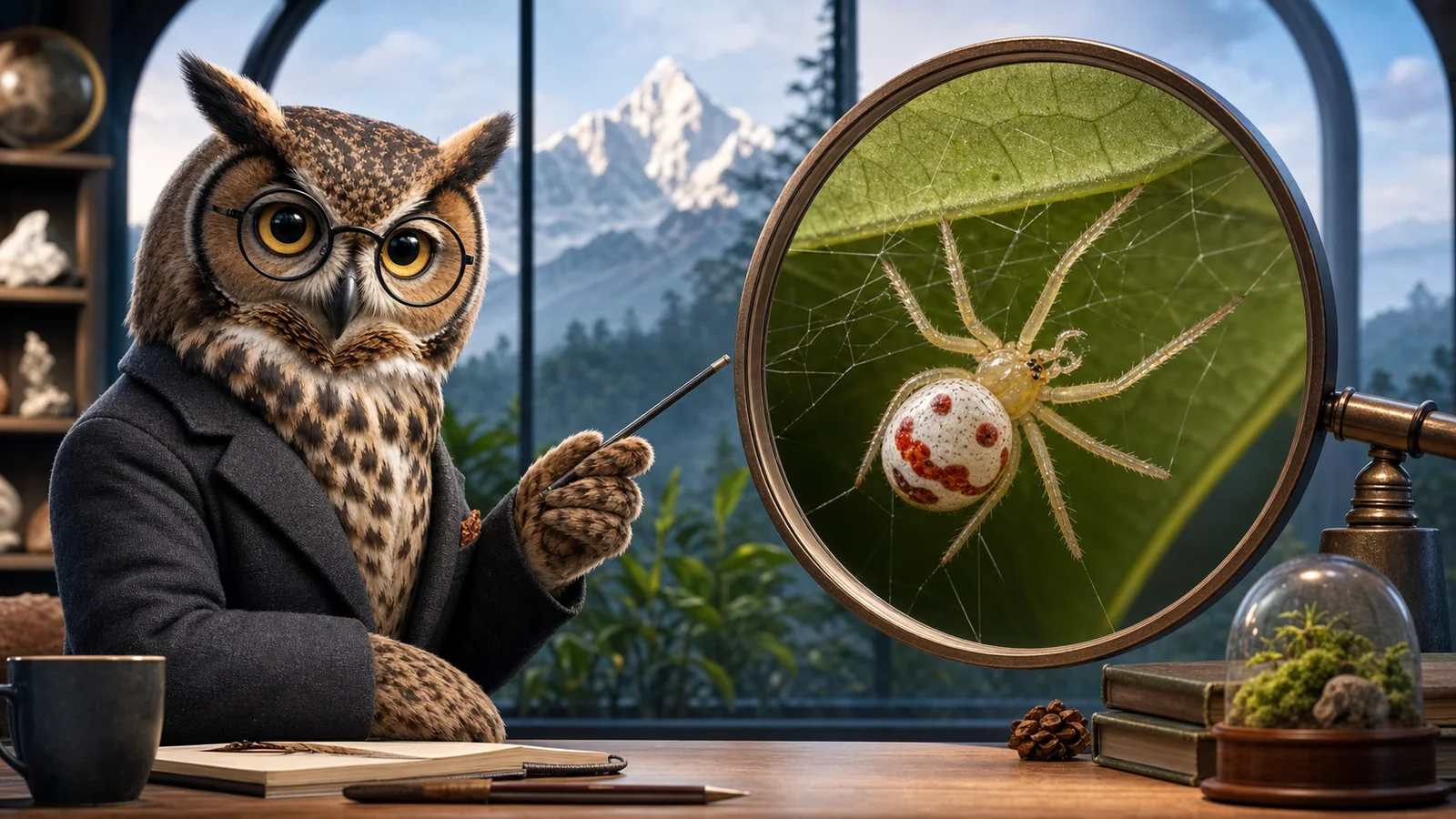
    Editorial illustration of Professor Hoot comparing several naturally varied spider abdomen patterns under magnifiers
    Professor Hoot reviews an editorial interpretation of spider polymorphism. The artwork is not a research specimen plate.

    One species, 32 wardrobe options

    The study documented 32 color variations, known as morphs. The patterns combine pale yellow or cream backgrounds with different arrangements of red, white, and dark markings. Many females in the sample carried the face-like pattern, while most males were comparatively plain.

    That makes the spider polymorphic: members of the same species can appear in multiple naturally occurring forms. The exact function of those patterns has not been settled. The researchers discuss possible roles involving survival and camouflage, but further work is needed before anyone awards the abdomen design department a trophy.

    A separate Research Matters explainer reports that the spiders were found hanging beneath broad leaves on fine silk in moist, temperate forests. The publisher release places the discovery above 2,000 meters in elevation and notes that specimens were often associated with ginger plants.

    A smile that asks more questions

    The discovery adds a distinct species to the cobweb-spider family and gives researchers another case for studying how strikingly similar patterns can arise far apart. It also underscores how much biodiversity remains to be documented in Himalayan forests.

    The responsible conclusion is not that spiders have developed brand strategy. It is that careful fieldwork, specimen comparison, and genetic analysis can turn an accidental find under a leaf into a formally described species—with 32 visible reminders that nature rarely settles for one outfit.

    Professor Hoot’s final assessment: “The face may be incidental. The paperwork is immaculate.”
    Sources

  • Arizona’s Ant Spa Puts Tiny Groomers on the Big Shift

    Arizona’s Ant Spa Puts Tiny Groomers on the Big Shift

    Professor Hoot, Science Desk — In southeastern Arizona, a group of ants appears to have opened a cleaning station for other ants. There is no appointment book, no cucumber water and, so far, no evidence that anyone has tried to sell a premium mandible package.

    The actual finding is stranger and better than the joke. Entomologist Mark Moffett, a research associate at the Smithsonian’s National Museum of Natural History, documented tiny cone ants from an undescribed species in the genus Dorymyrmex climbing onto much larger red harvester ants, Pogonomyrmex barbatus, and grooming them. The observation was described in the peer-reviewed journal Ecology and Evolution in April 2026.

    The desert’s smallest service counter

    Moffett noticed the behavior near a research station in Arizona’s Chiricahua Mountains. Harvester-ant workers were moving out to collect seeds when a few seemed to freeze near the nests of the smaller ants. A closer look revealed cone ants on their bodies.

    Over several days, Moffett watched at least 90 harvester ants receive attention. A harvester would approach a cone-ant nest, stand stiffly high on her legs and hold her serrated mandibles open. Usually within a minute, a cone ant emerged, climbed aboard and began inspecting the larger ant.

    The Smithsonian says the sessions ranged from less than 15 seconds to more than five minutes. As many as five cone ants could work on one harvester, licking and nibbling its body with tongue-like mouthparts — including the area between those open jaws. The larger ant tolerated the work without biting.

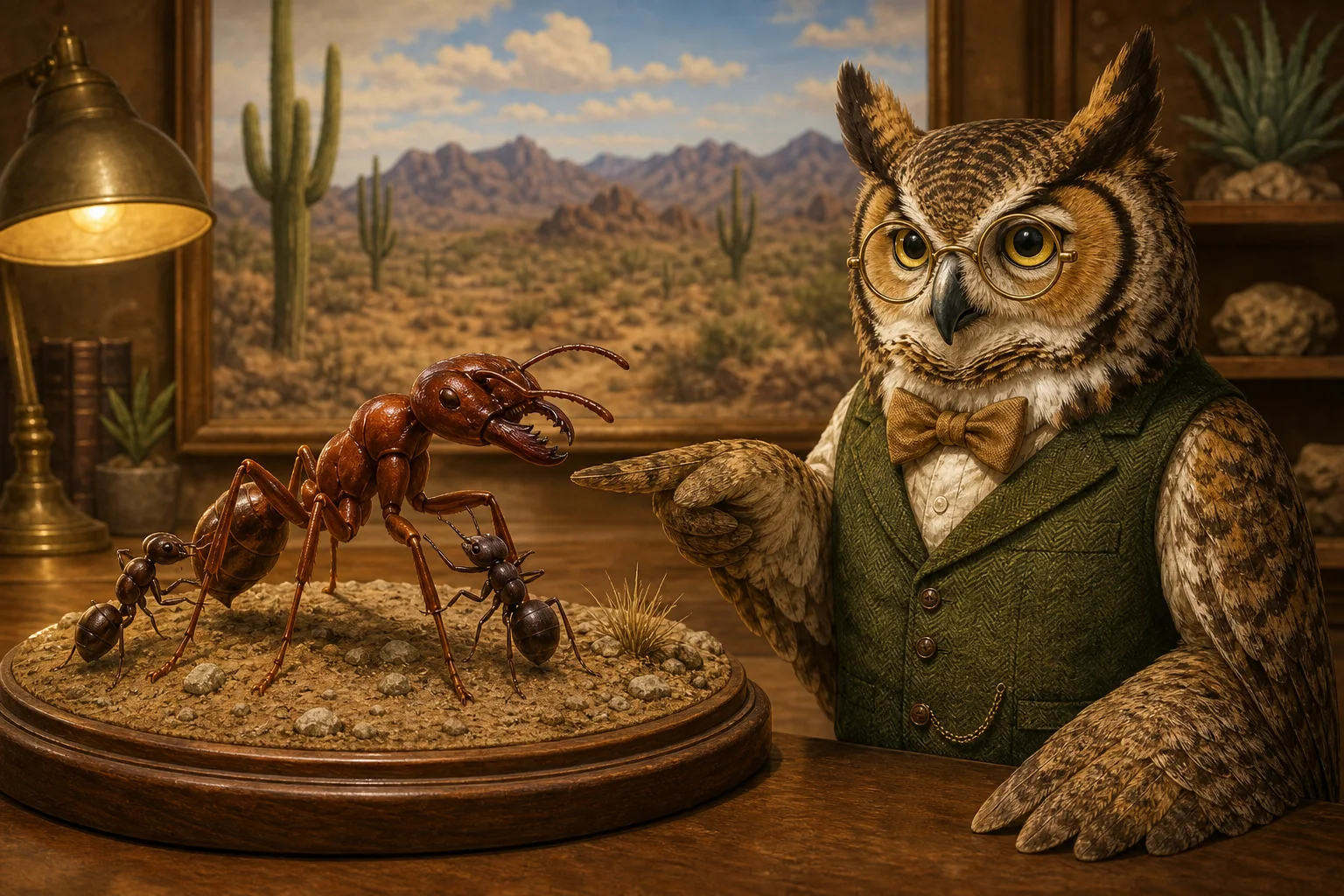
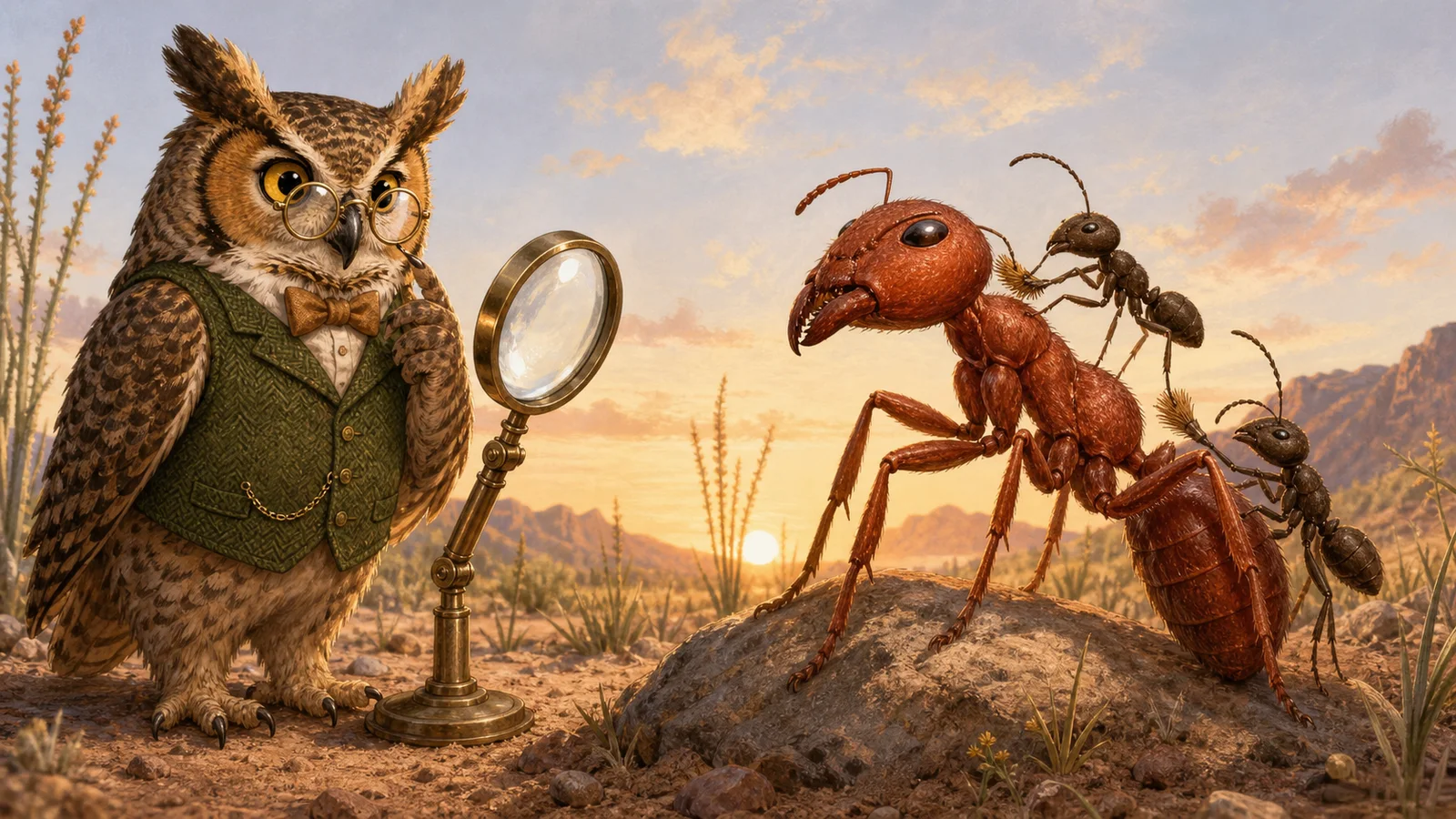
    Editorial illustration of Professor Hoot presenting a scale model of tiny cone ants grooming a much larger red harvester ant
    Professor Hoot presents the scale difference between the tiny cone-ant cleaners and their much larger harvester-ant customer. Original editorial illustration; not a documentary image.

    Departure was less graceful. When a harvester had apparently had enough, she bucked the smaller ants off so forcefully that she often ended up on her back before hurrying away. Every worker involved was female, which means this may be the most efficiently staffed spa in Arizona.

    “The protocol is precise: arrive, hold still, permit inspection, then conclude the appointment with an unscheduled backward somersault.”

    Professor Hoot, Hilarious News science host

    A first, with the benefits still under study

    The behavior resembles marine cleaning stations, where small fish or shrimp remove material from much larger animals. Moffett’s paper presents it as the first known case of one ant species cleaning a much larger ant species.

    What each species gets from the arrangement remains unresolved. One possibility is that the cone ants consume tiny, energy-rich particles left on the harvesters, perhaps flakes from the seeds the larger ants collect. Moffett also suggested that the smaller ants may reach places that a harvester’s nestmates cannot, potentially removing debris, spores or parasites. Future work would need to test whether the sessions reduce infections or change either species’ microbiome.

    There is one particularly interesting clue: the cone ants attended living harvesters but did not clean frozen specimens placed near their nests. That suggests the interaction is more specific than a simple interest in ant-shaped objects.

    Nature’s latest workplace comedy therefore ends with an honest scientific answer: the grooming is real, the choreography is documented, and the payment system is still under investigation.

    Professor Hoot’s final desk note: “Please resist calling it a manicure. Ants do not have hands, and precision in terminology is the first defense against chaos.”

    Sources