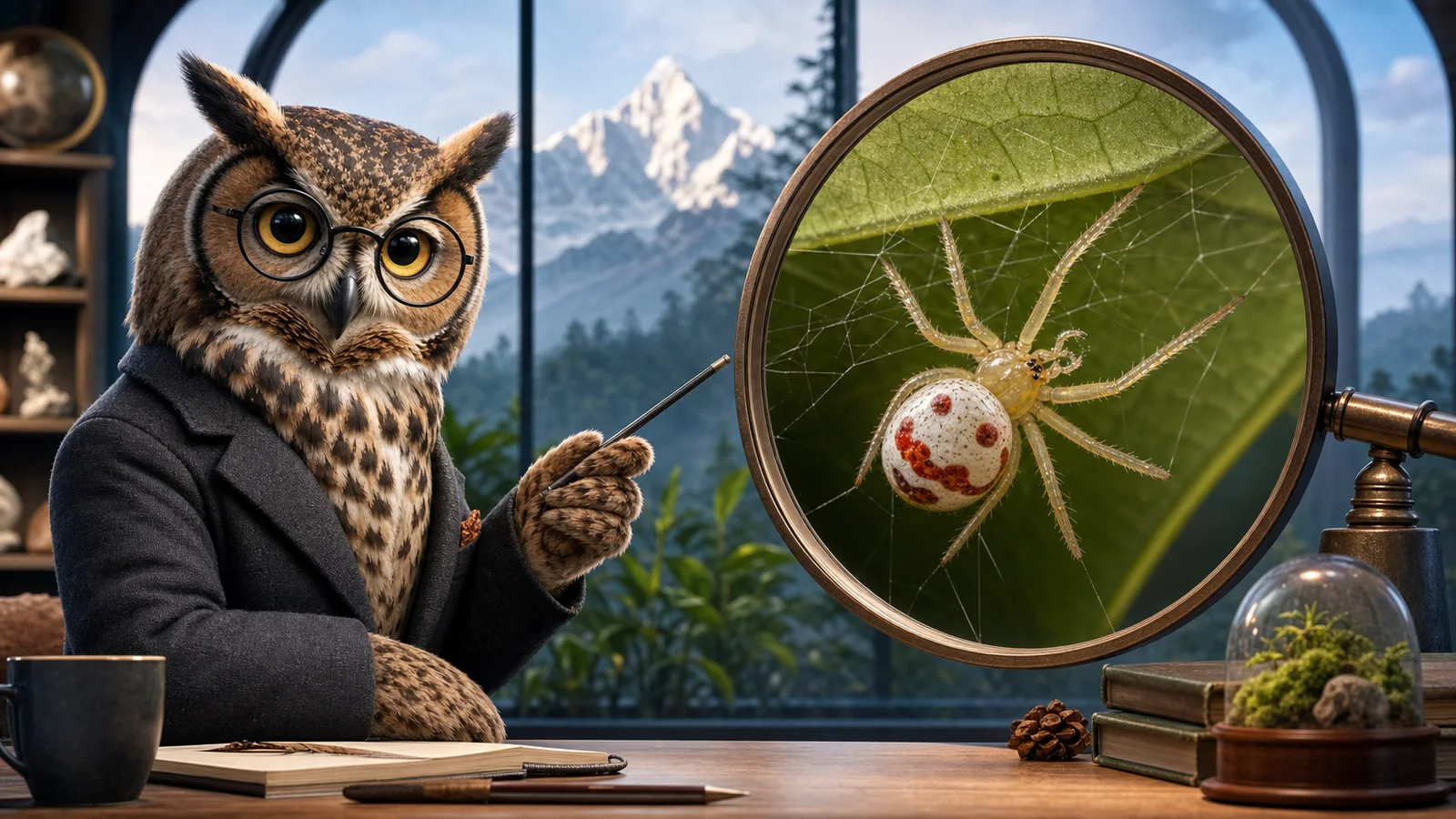
Professor Hoot, Hilarious News science and technology reporter, has reviewed the research and would like the record to show that the spider’s expression is “encouraging, though not peer-reviewed.”
A newly described cobweb spider from India’s Western Himalayas has arrived with the sort of markings that make an arachnid look unexpectedly pleased with quarterly results.
Researchers Ashirwad Tripathy and Devi Priyadarshini formally described Theridion himalayana in the open-access journal Evolutionary Systematics. The tiny spider is commonly called the Himalayan happy-face spider because many individuals carry red, white, and dark markings on the abdomen that can resemble a smiling face.
The resemblance is visual, not emotional. Scientists have not established that the spider is delighted, amused, or even mildly satisfied. It is still a spider. Professor Hoot considers this an important distinction for readers preparing invitations.
An ant survey found a spider jackpot
According to a publisher news release about the peer-reviewed study, the discovery began by accident. The original field survey focused on ants, but Tripathy kept sending high-altitude spider specimens to Priyadarshini for identification. A spider photographed beneath a leaf stood out because it resembled Hawaii’s famous happy-face spider, Theridion grallator.
The researchers collected more than 60 specimens from Makku, Tala, and Mandal in Uttarakhand. Their formal taxonomic paper identifies the Himalayan population as a distinct species using physical characteristics and DNA evidence. The two happy-face spiders are lookalikes from separate lineages, not one species with an extremely ambitious travel itinerary.
“Convergent whimsy,” Professor Hoot observed, “remains whimsy with documentation.”
One species, 32 wardrobe options
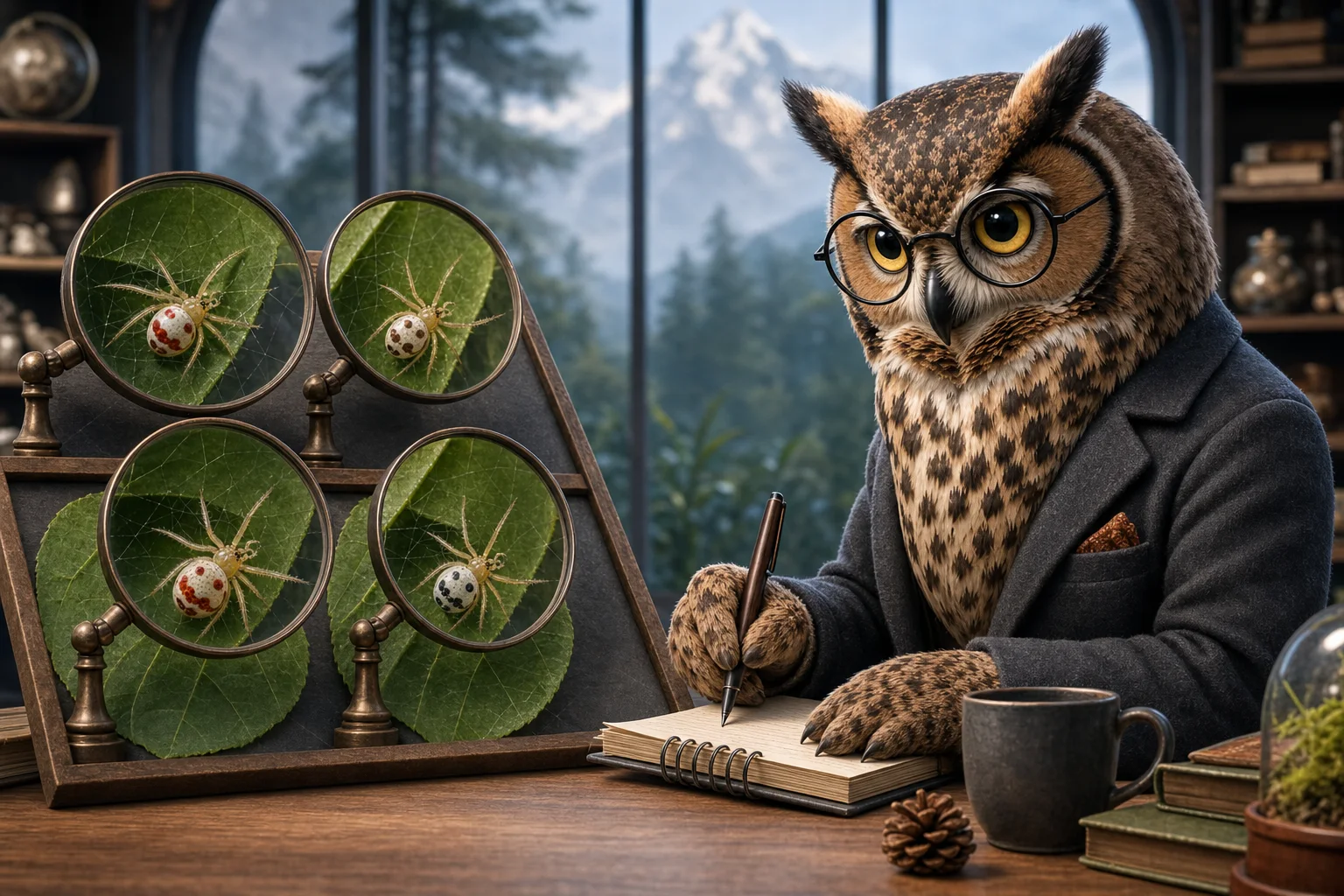
The study documented 32 color variations, known as morphs. The patterns combine pale yellow or cream backgrounds with different arrangements of red, white, and dark markings. Many females in the sample carried the face-like pattern, while most males were comparatively plain.
That makes the spider polymorphic: members of the same species can appear in multiple naturally occurring forms. The exact function of those patterns has not been settled. The researchers discuss possible roles involving survival and camouflage, but further work is needed before anyone awards the abdomen design department a trophy.
A separate Research Matters explainer reports that the spiders were found hanging beneath broad leaves on fine silk in moist, temperate forests. The publisher release places the discovery above 2,000 meters in elevation and notes that specimens were often associated with ginger plants.
A smile that asks more questions
The discovery adds a distinct species to the cobweb-spider family and gives researchers another case for studying how strikingly similar patterns can arise far apart. It also underscores how much biodiversity remains to be documented in Himalayan forests.
The responsible conclusion is not that spiders have developed brand strategy. It is that careful fieldwork, specimen comparison, and genetic analysis can turn an accidental find under a leaf into a formally described species—with 32 visible reminders that nature rarely settles for one outfit.
Professor Hoot’s final assessment: “The face may be incidental. The paperwork is immaculate.”
Leave a Reply